01
Map the pilot portfolio.
The AI Readiness Assessment settles which pilots can reach the line, what the integration actually requires, and, in the same pass, the honest regulatory read of what you run.
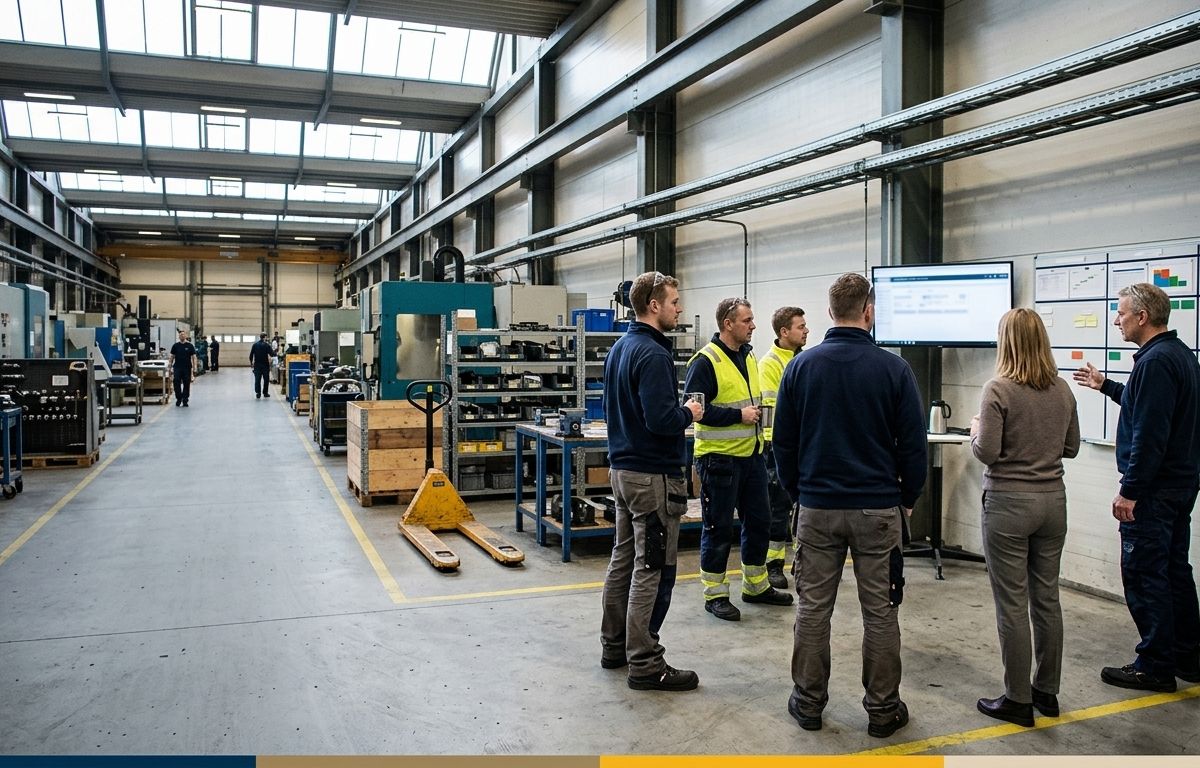
WHERE INDUSTRIAL AI ACTUALLY DIES
The pattern repeats across Swedish industry. A proof of concept runs beautifully on exported data. Then production needs the real thing: live signals from the machines, order data from the enterprise resource planning (ERP) system, quality data from systems that were never meant to talk to each other, and a named owner on the floor.
The operational technology (OT) and IT sides meet, the integration is harder than the model ever was, and the pilot goes into the drawer.
The human layer follows the same logic. On most shop floors, a few people are already using AI quietly, and the rest hold back, not from resistance but from uncertainty about what is allowed. None of that is a model problem. All of it is buildable.
WHAT WE BUILD
An honest distinction first. Quality vision, predictive maintenance and planning optimisation are often less AI than the brochures claim: much of it is machine learning industry has run for years, and some of it is classic automation. Frequently that is the right tool, and telling you which is which is part of the job.
What we deliver ourselves is the knowledge work around production, where language-model AI earns its keep today. The office side of the factory: order handling, certificates, supplier documentation and quotation support, often the fastest payback in the building.
And operator assistants on your own manuals, maintenance history and quality instructions, answerable in seconds. And the analysis your machines already wrote: logs, quality records and maintenance history turned into decision bases, which machine to replace, where the scrap originates, whether the investment case holds.
For the systems that watch and control the line, vision, condition monitoring, predictive maintenance, we do what an independent adviser should and nothing more: write the decision basis, run the evaluation, and sit on your side of the vendor table.
Building and running systems that watch machines is your integrator's craft, not ours. Our criterion goes into your requirement spec instead: a prediction that doesn't reach your maintenance system is a report.
All of it delivered the way we deliver everything: production criteria from day one, built to be owned, transferred with documentation your own team runs. Fixed price, and we carry the overrun.
HOW LITTLE ACTUALLY APPLIES TO YOU
Here is the read most suppliers won't give you: the high-risk requirements in the EU AI Act were written around safety functions, and the definitions explicitly exempt AI used solely for non-safety-related aspects of quality control, performance optimisation, service efficiency, automation and convenience.
Quality vision, predictive maintenance, process optimisation and production planning sit outside. What remains in scope is the genuinely safety-critical sliver: AI that itself performs a safety function, where a failure endangers people. Even there, the detailed machinery requirements arrive through rules that are still being written.
That is also the track furthest out in time, and for machinery it changed in July 2026. AI built into products belongs to Annex I, with requirements from 2 August 2028, but machinery moved that month into Section B of Annex I. The AI requirements for a machine therefore arrive through the Machinery Regulation's own Annex III rather than through the EU AI Act's chapters. AI sitting inside a product is not automatically high-risk: the intended safety purpose decides. The whole amendment is read in our review of the Machinery Directive and AI.
Two things are worth knowing today. Emotion and fatigue recognition of your operators is banned already, since 2 February 2025, unless it sits inside a narrow safety exception, and design decides the outcome: a system that stops the machine stands on far firmer ground than one that feeds a performance review.
And systems that score your people, rather than your machines, sit on the high-risk list. That is Annex III point 4, and the obligations there apply from 2 December 2027, on a clock of their own and earlier than the Annex I track for AI built into products.
A small minority of industrial AI systems are covered. Saying so is not a sales strategy. It is just true.
FOUR STEPS, WITH THE FLOOR ALONG
The AI Readiness Assessment settles which pilots can reach the line, what the integration actually requires, and, in the same pass, the honest regulatory read of what you run.
Implementation of the analysis and assistant layer on your own data, owned by your team at handover. For the systems that watch the line, we write the requirements and your integrator builds.
Adoption with your operators alongside, not instead of them, and the clarity about what is allowed that unfreezes quiet non-use.
Executive sessions delivered by Ampliro, and role-specific programmes for operators and staff through AIUC, our education arm.
PROOF
Our industrial work includes executive sessions for the leadership team at Getinge, engagements with teams at Marieholm Salt Specialties, and delivery for mid-size manufacturers across Sweden. The consultant who leads your engagement is the person who delivered those.
QUESTIONS
An AI pilot that never reaches production almost never fails on the model. It fails on the integration between the side that owns the machines, operational technology, and IT; on data that existed as exports but never in real time; and on nobody on the floor being given ownership. We start by settling which of the three it was, because the fix is completely different in each case. You get either a scoped path to daily use or an honest recommendation to shut the pilot down.
CE marking under the Machinery Directive or the Machinery Regulation is not in itself proof of conformity with the EU AI Act, but since 27 July 2026 there is one track rather than two. Regulation (EU) 2026/1744 moved machinery into Section B of Annex I, so the EU AI Act's heavy high-risk requirements no longer apply to AI in machinery. Those requirements are instead to be placed in the Machinery Regulation's own Annex III, through delegated acts that must apply by 2 August 2028. AI sitting inside a machine is not automatically high-risk: the intended safety purpose decides. The whole amendment is read in our review of the Machinery Directive and AI.
Machine vision used solely for non-safety-related aspects of quality control is normally not high-risk under the EU AI Act, because that use is explicitly excluded from the safety-component definition. The qualifier does the work: a quality control that decides whether something is safe does not fall outside. The line goes at safety functions, and if a failure of the system would endanger people the picture changes. For a machine the requirements then arrive through the Machinery Regulation's Annex III, applying by 2 August 2028. We help you draw that line in the AI Readiness Assessment.
Predictive maintenance and condition monitoring normally fall outside the high-risk requirements of the EU AI Act, because optimising availability is not a safety function. The exception is a system that itself prevents the machine from causing harm. That is a different classification and a different build, and for a machine the requirements then arrive through the Machinery Regulation's Annex III, applying by 2 August 2028.
A manufacturer with no high-risk systems is still reached by three things in the EU AI Act. The AI literacy requirement in Article 4 and the prohibitions in Article 5 have applied since 2 February 2025. The transparency obligations in Article 50 apply from 2 August 2026, meaning disclosure where content is AI-generated. And the deployer duties that follow from all three land on your legal entity, not on the supplier who sold you the tool. None of it depends on a high-risk classification.
Emotion recognition and fatigue detection of operators in the workplace have been prohibited under the EU AI Act since 2 February 2025, with a narrow exception for medical and safety reasons. Design decides the outcome: a system that stops the machine stands on far firmer ground than one that feeds a performance review. The prohibition is absolute rather than a matter of degree, so the design question is worth settling before the system is built rather than after.
Yes, AI used for recruitment and for assessing employees is high-risk under the EU AI Act even in a manufacturing company. Recruitment and selection sit in Annex III point 4, and those requirements apply from 2 December 2027, earlier than the Annex I track for AI built into products. It is the most common route into the high-risk rules for a manufacturer. The fundamental rights impact assessment in Article 27, by contrast, normally does not bind a private industrial company.
Manufacturing data locked in the machines is usually easier to reach than the integration brochures suggest. Logs, quality records and maintenance history can be exported and analysed long before anyone builds real-time connections, and that analysis alone is a decision basis. When live integration is worth it we write the requirements, your integrator builds, and you own what arrives. The order is set in the AI Readiness Assessment.
INSIGHTS

A machine with AI inside looked as though it carried two sets of requirements. Since late July the Machinery Directive and its successor decide alone, and the rules replacing the others are not written yet.
Read the analysis
A language model was run across 16,316 maintenance logs and corrected the maintenance type on one record in four. The logs carried the answer all along; the summaries built from them did not, and that is the difference between owning data and having asked it anything.
Read the analysisOne conversation settles whether the gap is data, integration or ownership, and confirms how little of the rulebook actually applies to you. If a rule does apply, you will know which, and what meeting it costs. If the right first step is not AI at all, we will say so.