01
Find the three processes.
An AI Readiness Assessment at unit scale, priced fixed, that names the three and proves the case on your own data. Already ran a pilot that stalled? That is exactly where we start.
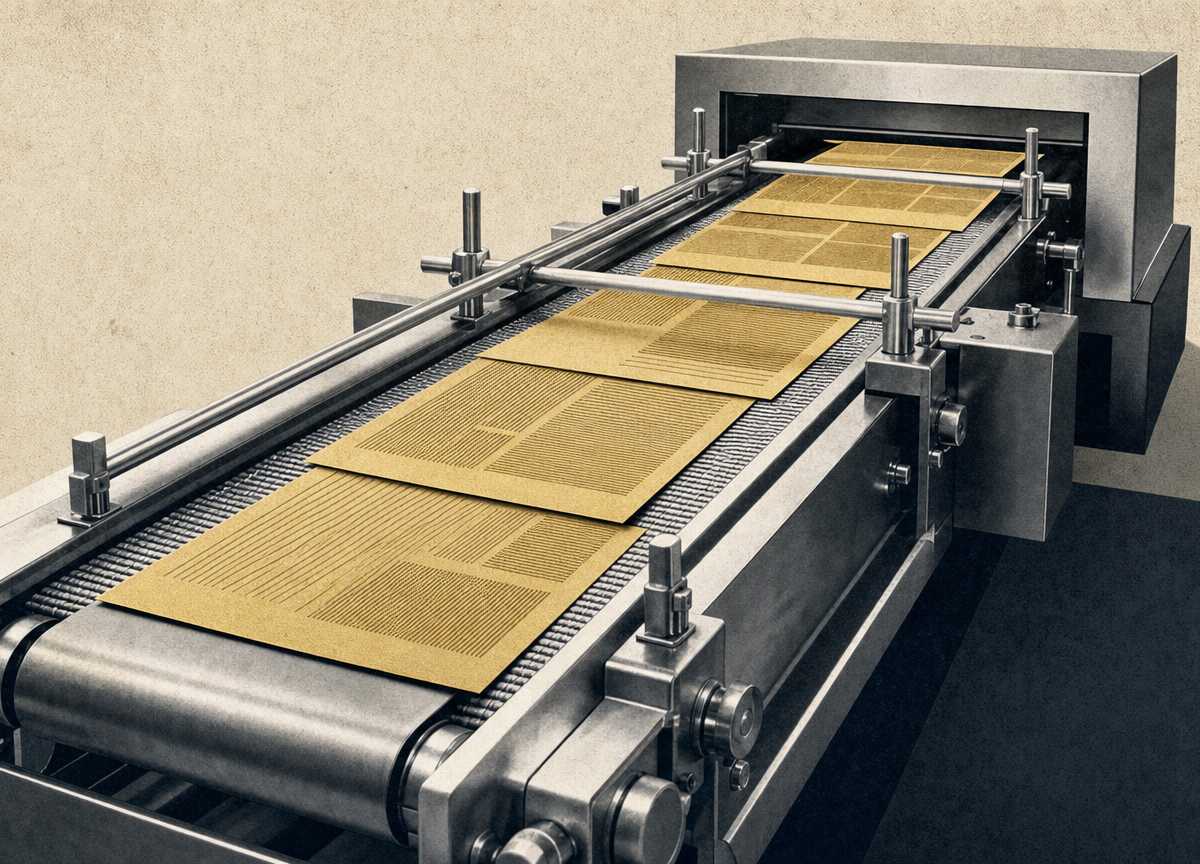
A FORECAST YOUR PLANNER TRUSTS
Your own history already holds the better forecast, the production plan and the quality file, built into the systems you run and owned by your team. And the AI rules you keep hearing about barely apply here.
THE DRAMATISATION
The sector has been told that AI is an existential question, that the disruption is imminent, and that a strategy deck is the answer. It responds the way people respond to prophecy: with paralysis, or with pilots nobody puts into operation. Both cost more than the technology ever will.
Here is the calmer truth. Value in this sector is not a moonshot. It is a forecast the planner actually trusts. A production plan that survives Monday morning. A quality file that writes itself from data you already collect.
Supplier and certificate administration that stops leaking hours. Month-end reporting to the group that stops eating your best people. Concrete, measurable, and integrated into the enterprise resource planning (ERP) and planning systems you already run.
We de-dramatise when everyone else dramatises. Not because AI is small here, but because the useful part of it is mundane. And the mundane part is not marginal.
THREE PROCESSES
That depends on your operation, and finding them is a short diagnosis, not a strategy programme. In this sector the answer usually hides among five candidates: demand forecasting, production planning, quality documentation, supplier and certificate administration, and the recurring reporting your unit owes the group.
The pattern across them is the same. Your history already contains the answer: sales, orders, deviations, complaints, batches. AI turns that history into decision bases your planners and quality staff act on. The forecast proposes, the planner decides. The deviation analysis points, the quality manager acts.
Decision support for your people, never automated decisions over their heads, and never systems that watch the line. We will not build the camera that inspects your production. Give us the quality records and the complaints log, and you will know where the deviations start.
Built at unit scale, fixed price, in your systems, owned by your team at handover. If the honest finding is that one of your three processes needs a spreadsheet fix rather than a model, you will hear that too. Choosing not to use AI is still the most underrated AI decision.
THE RULES
You will not find a regulatory sales pitch on this page, because there is none to make. What the EU AI Act asks of a company like yours is modest: measures that help staff use AI competently, the Article 4 duty that has applied since 2 February 2025, and transparency where content is AI-generated, Article 50 from 2 August 2026.
The heavy obligations you read about are aimed at other kinds of systems, and the exposure here is low. The exception is recruitment, which is Annex III point 4 and therefore high-risk from 2 December 2027, because everybody recruits. Saying so costs us nothing but a scare tactic we did not want anyway.
Your binding rulebook is older and stricter: food safety, traceability, HACCP and the certification schemes your customers audit you against. AI in this sector has to fit inside that regime, not beside it. Every document flow we build respects the quality system you already answer to, and produces the records your auditor expects to find.
THE GROUP DIRECTIVE
Nearly every company in this sector is someone else's subsidiary. So the odds are that your AI question did not start here. It started as a deck from group headquarters, a licence agreement signed somewhere else, or a silence you suspect will end with a question about your AI adoption.
Two things are worth knowing. The AI Act's deployer duties are EU law, and they land on your Swedish legal entity no matter who chose the tools. And that whole situation has its own page: what is actually decided, what is yours to decide, and what Swedish law requires before go-live.
WHERE TO START
An AI Readiness Assessment at unit scale, priced fixed, that names the three and proves the case on your own data. Already ran a pilot that stalled? That is exactly where we start.
Implementation of the forecasting, quality or documentation layer on your own history, integrated where your team already works, owned at handover.
Adoption measured for effect, not attendance, so the planner actually trusts the forecast.
Leadership sessions from us, breadth through AIUC, our education arm, in Swedish, on your actual workflows.
If the deck came from headquarters, start on the page built for that situation.
PROOF
We work with teams at two units within Groupe Salins: Marieholm Salt Specialties in Sweden and Mariager Salt in Denmark, alongside industrial and consumer-sector clients across the Nordics.
QUESTIONS
A food or consumer goods company is covered by the EU AI Act, but for the most part not as high-risk. Annex III rarely reaches you, and the fundamental rights impact assessment in Article 27 normally not at all. Two things still apply: the AI literacy requirement in Article 4, in force since 2 February 2025 and regardless of risk level, and the transparency obligations in Article 50 from 2 August 2026. The most common route into the high-risk rules is recruitment.
AI-generated marketing material has to be recognisable as synthetic, and the obligation is the transparency requirement in Article 50 of the EU AI Act, which applies from 2 August 2026. It covers image, video, audio and text in campaign planning, packaging copy and range material. Generative systems already on the market have until 2 December 2026 under Article 111(4) to bring their outputs into line with the marking requirement in Article 50(2). This is the first obligation your sector meets, and it reaches you whether or not any system is classified as high-risk.
Yes, AI in recruitment is high-risk under the EU AI Act, in any sector. Recruitment and selection of workers sit in Annex III point 4, and the high-risk requirements for Annex III apply from 2 December 2027. It is the most common route into the high-risk rules for a company like yours, because everybody recruits. No harmonised standards are published yet, so conformity is shown with your own documentation.
An AI pilot that stalled in a food company has already taught you the expensive lesson: deployed is not adopted. A tool that lives outside the workflow dies outside it. We start from the pilot, find where it lost contact with the daily work, and scope the path into operation. The work sits in Adoption & Change, and the effect is measured on use in the process rather than on attendance.
Demand forecasting for food production has been built on worse than spreadsheets and an ageing enterprise resource planning system. Your sales history, orders, deviations and complaints can be exported and analysed long before anyone replaces a system, and that analysis alone is a decision basis. When deeper integration is worth it we write the requirements and you keep control of the build. The AI literacy requirement in Article 4 of the EU AI Act applies from day one, whatever the age of the systems.
A Swedish unit keeps both obligations and decision room when the group chooses the tools. The EU AI Act's deployer duties land on your legal entity: the AI literacy requirement in Article 4 since 2 February 2025, the transparency obligations in Article 50 from 2 August 2026, and responsibility for how the systems are used. Your workflows, your data and the order in which you adopt are yours as well.
INSIGHTS
One conversation. Bring the process that annoys you most: the forecast nobody trusts, the plan that lives in one head, or the quality binder that eats Fridays. We will tell you whether AI improves it, by how much, and what finding out costs. If a spreadsheet fix beats a model, we will say so.